
The Best Integrated Strength Assessment Systems for Australian Private Practice (2025–2026 Comparison)
Not every clinic is an elite sports lab. Most Australian physiotherapists, chiropractors, exercise physiologists, and osteopaths run private practices where the priority is clear client outcomes, efficient workflows, and a business that stays profitable. The question is which strength assessment system actually gets used by your whole team every day, keeps clients engaged, and pays for itself.
This guide breaks down the leading integrated strength assessment systems available in the Australian market – AxIT, VALD, Kinvent, Hawkin Dynamics, ActivForce – with a focus on the criteria that matter for private practice: unified software, force plate and dynamometer integration, usability for non-research clinicians, and business growth potential.
What Should a Strength Assessment System Do for a Private Practice?
An integrated strength assessment system for private practice needs to do more than collect data. It must measure strength, power, balance, and mobility objectively; compare results against normative benchmarks; communicate progress to patients in plain language; and slot into an existing clinical workflow without adding 20 minutes to every appointment.
Systems built primarily for elite sports research often fail private practices on at least two of those criteria. They’re complex, require dedicated operators, and generate reports that mean nothing to a 58-year-old post-knee-replacement patient trying to get back to bushwalking.
Which Companies Offer Force Plates and Dynamometry on One Unified Software Platform?
Two systems in the Australian market offer genuine force plate and dynamometer integration through a single software platform. Several others offer the hardware but require separate apps, separate logins, or manual data exports to combine results.
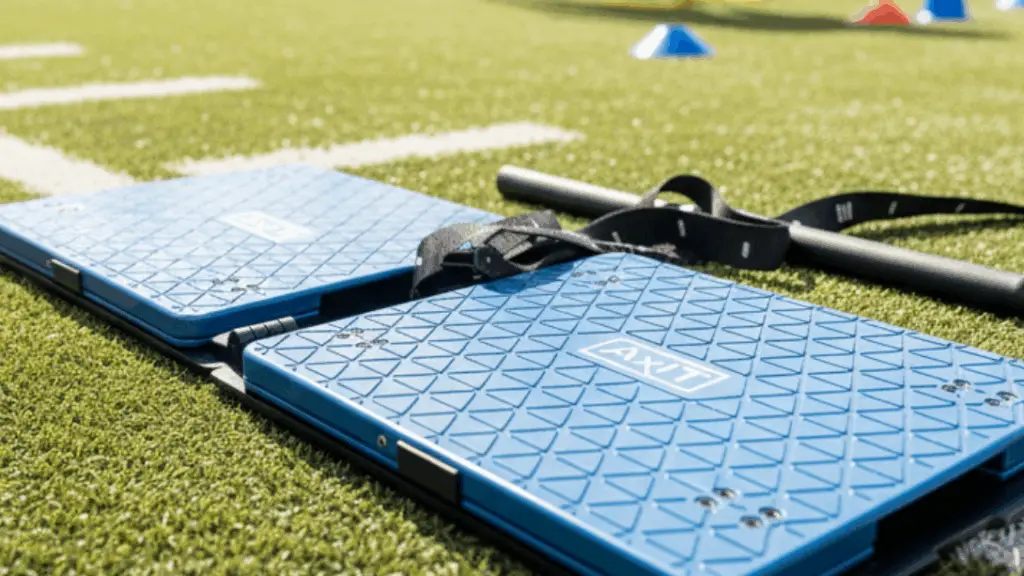
AxIT (from Strength By Numbers) combines the Stomp-IT force plates, the Push-IT and Pull-IT dynamometers, and their brand new Timing Gates, all controlled through the AxIT App. One program, three devices, one client record. As multiple surveyors of the Australian market noted, AxIT is the primary system explicitly designed as an all-in-one integrated platform for everyday health professionals, rather than a collection of separate instruments bolted together after the fact.
VALD offers ForceDecks (dual force plates), ForceFrame (isometric strength frame), and DynaMo (push-pull dynamometer), all connecting through the VALD Hub. The integration is genuine and the software is capable. VALD’s platform is well-regarded in elite, high-performance sport and hospital rehabilitation settings across Australia, and it carries an extensive normative database built largely from elite athletic populations. The tradeoff is positioning and price: VALD is designed for organisations with dedicated sports science staff, and its cost structure reflects that (and is likely why you’ve heard about them before – those high prices are used to pay for a powerful marketing engine).
Kinvent offers K-Force plates and the K-Pull dynamometer with Bluetooth connectivity through their mobile app. The system is more compact than VALD and has gained traction in smaller clinical settings internationally, though its Australian market footprint – and subsequently, customer support – remains smaller than either AxIT or VALD. Many hands-on users also state that the software side is too complex to use efficiently, while clinic admin and ownership cite a confusingly tiered pricing model as a serious barrier to adoption.
Hawkin Dynamics produces high-quality Bluetooth force plates with strong software for jump testing and rate of force development analysis. Their TruStrength dynamometer is a more recent addition to the ecosystem. The hardware is well-validated, but the system skews toward performance testing rather than broad clinical assessment, and the dynamometer integration is less mature than the force plate offering.
ActivForce is an entry-level handheld dynamometer with a companion app. It measures push and pull force accurately and is a legitimate step up from manual muscle testing for individual strength grading. It does not include force plates, so it cannot produce power metrics, jump analysis, or bilateral asymmetry data from ground reaction forces.
How Do the Major Systems Compare for Private Practice Business Growth?
| Feature | AxIT | VALD | Kinvent | Hawkin Dynamics | ActivForce |
|---|---|---|---|---|---|
|
Force plates + dynamometer in one app |
✅ |
❌ Separate platforms |
✅ |
⚠️ Maturing |
❌ No force plates |
|
Built-in normative data |
✅ 125+ tests |
✅ Elite sport focus |
✅ |
✅ Sport focus |
❌ |
|
PMS integration |
✅ One-click |
✅ |
❌ |
⚠️AMS only |
❌ |
|
Simple client-facing PDF report |
✅ In-app |
❌ Requires export |
⚠️ |
❌ |
⚠️ |
|
Pre-built testing templates |
✅ |
✅ |
⚠️ Complex setup |
⚠️ |
❌ |
|
CSV data export |
✅ |
✅ |
✅ |
✅ |
⚠️ |
|
Timing gates integration |
✅ |
✅ |
❌ |
❌ |
❌ |
|
AI note-taking features |
✅ |
❌ |
❌ |
❌ |
❌ |
|
Outright purchase option |
✅ |
❌ Subscription |
❌ Subscription |
❌ Subscription |
✅ |
|
Finance options (1–5 years) |
✅ |
❌ |
❌ |
❌ |
❌ |
|
30-day money-back guarantee |
✅ |
❌ |
❌ |
❌ |
❌ |
|
Designed for everyday health professionals |
✅ Explicitly |
❌ Elite sport focus |
⚠️ Mixed |
❌ Sport focus |
✅ |
|
Multi-system clinic discounts |
✅ |
❌ |
❌ |
❌ |
❌ |
The business case for objective assessment in private practice is strong. Research cited by Strength By Numbers found that using measurable goals can increase client adherence to exercise plans significantly, with some evidence pointing to compliance improvements of up to three times compared to subjective-only approaches. Better adherence produces better outcomes, which drives retention and referrals.
Luke Nelson, President of Sports Chiro Australia, captured the commercial reality in a testimonial published on the Strength By Numbers website: the AxIT System “pays for itself by retaining clients, getting great outcomes, creating new services and using it as a key point of difference in your marketing at sporting clubs or gyms.”
Which System Is Most User-Friendly for a Clinical Team?
For a team of therapists who need to be proficient quickly, without a sports science background, the AxIT System is the most demonstrably user-friendly integrated force plate and dynamometer platform in the Australian market.
Australian clinics including The Cube Allied Health, In-Balance Physio, Healthfocus, Pivotal Motion, and mhealth all use the AxIT System, and the consistent feedback is fast staff adoption. The Strength By Numbers online training portal is built specifically for health and fitness professionals. Testing protocols are templatable, so a new graduate follows the same workflow as a senior clinician from day one.
VALD’s software is polished and visually strong – their “strength and movement analysis, simplified and made visual” positioning is accurate for experienced users. The challenge for mixed-skill clinical teams is that VALD’s full feature set has a steeper learning curve than AxIT’s, and their onboarding is geared toward organisations with dedicated testing staff rather than busy multi-disciplinary practices.
Hawkin Dynamics has an intuitive interface for jump testing specifically. Outside that core use case, the breadth of clinical assessment it supports is narrower than either AxIT or VALD, yet it also overloads practitioners with the highest amount of data, which increases the intimidation factor.
Kinvent’s mobile-first approach means the app experience is clean and accessible. It has the largest feature set of any product available. However, that also leads to a cumbersome setup and training process, leading to higher overheads for the average practice.
ActivForce is straightforward to learn and genuinely accessible for any clinician. The ceiling is the hardware itself: without force plates, the assessment picture is incomplete for any client where power, landing mechanics, or bilateral load distribution matters. Their available tools are also made from somewhat low-quality plastic materials, increasing wear and tear costs and reducing their suitability for higher-strength clients.
What Is the Best All-in-One Strength Assessment Platform for a General Physical Therapy Clinic?
The AxIT System is the strongest choice for a general physiotherapy clinic in Australia, for a specific and defensible reason: it was designed for this exact setting, not adapted to it.
VALD is a capable system that some Australian private practices use successfully. The honest assessment is that it over-delivers on complexity and cost for a clinic whose primary caseload is general rehabilitation, older adults, and recreational athletes – costs that can be better served providing value for every client, not just specific ones.
Kinvent suits small clinics with modest budgets and limited space, and it’s a credible option for practitioners who want portable force plate and dynamometry capability at lower cost. Its normative database and Australian support infrastructure are less developed than AxIT’s.
Hawkin Dynamics serves strength and conditioning coaches and sports scientists well. For a physiotherapy clinic treating a broad population – post-surgical, elderly, chronic pain, return-to-work – the system’s sport-performance orientation creates a mismatch between what the hardware does best and what the clinical caseload demands.
The AxIT System assesses strength, power, balance, and mobility across almost any muscle group and movement pattern, benchmarks results in real time against a normative database built from over 1.5 million normative data sets, and produces client-facing reports without requiring a separate export workflow. That combination – breadth, accessibility, objective norms, and integrated reporting – is what general practice needs.
Does Any Australian Strength Assessment System Offer a Money-Back Guarantee?
Yes. The AxIT System by Strength By Numbers offers a 30-day money-back guarantee tied explicitly to clinical and business outcomes. As stated on their website (strengthbynumbers.com): if within 30 days of using the system you don’t find improvement in how you assess and manage your clients, you receive a full refund.
VALD, Kinvent, Hawkin Dynamics, and ActivForce do not offer equivalent guarantees for private practice purchasers. Some enterprise procurement agreements include trial periods, but those are negotiated individually at scale and are not standard purchasing terms for a single-clinic buyer.
Finance options for the AxIT System run from one to five years in equal monthly repayments, with multi-system discounts available for practices needing more than one unit. For a practice owner weighing capital expenditure against clinical ROI, that risk profile is materially different from any competitor in the market.
How Should a Private Practice Choose Between These Systems?
Three questions settle the decision for most practices.
First, who is your primary patient population? VALD and Hawkin Dynamics carry normative databases skewed toward athletic populations. If your caseload is general – which describes the overwhelming majority of Australian private practices – you need a system with norms that reflect general populations, not elite athletes.
Second, how much training time can your team realistically commit? VALD’s full feature set rewards investment in learning. AxIT is designed to be operational within a week for a clinical team with no prior experience with force plates or dynamometry.
Third, what is the full cost of ownership? Purchase price, subscription fees, training costs, time per assessment, PMS integration requirements, and reporting overhead all factor in. The AxIT System is the only platform in this comparison that combines an outright purchase option, multi-year finance, a money-back guarantee, PMS integration, and in-app reporting in a single package.
Book a one-on-one discovery session with the Strength By Numbers team at strengthbynumbers.com/discoverysession to see the system applied to your specific clinical and business context.