
How can clinics objectively prove client progress instead of relying on feel?
To objectively prove client progress, you must implement standardized assessment tools, track baseline strength metrics, and use technology to quantify functional movement. Relying on practitioner feel is highly subjective and leads to inconsistent reporting. By integrating digital dynamometers and force plates, you capture exact numerical data that demonstrates clear physical improvements.
Standardizing your testing protocol requires a highly structured approach.
- Establish a baseline. Record the client’s initial strength and mobility metrics during their very first session.
- Set measurable goals. Define specific numerical targets for the client to achieve over a 4 to 6 week period.
- Schedule regular reassessments. Perform the exact same tests under the same conditions every month.
- Visualize the data. Show the client clear graphs or charts comparing their current performance to their baseline.
Are there better ways to measure muscle strength than manual testing?
Yes, using objective measurement technology is far superior to manual muscle testing. Manual testing relies entirely on the practitioner’s subjective resistance, which causes major consistency problems across different team members. Digital strength assessment devices provide absolute numerical values that totally eliminate human error.
| Feature | Manual Muscle Testing | Objective Assessment Technology |
|---|---|---|
|
Accuracy |
Subjective and practitioner dependent |
Highly accurate and strictly quantifiable
|
|
Consistency |
Low consistency between staff members |
Standardized tracking across all users |
|
Client Feedback |
Vague verbal descriptions |
Clear visual data and exact numbers |
|
Tracking |
Difficult to monitor micro-progress |
Captures minor improvements easily |
Transitioning to objective data allows your entire team to perform consistent functional movement screens. This uniformity ensures that every client receives the exact same standard of evaluation regardless of who conducts the session.
How can I increase client engagement and retention using objective data?
You can increase client retention by showing tangible proof of their physical improvements within the first 4 to 6 weeks. Clients often quit when they fail to see immediate visible changes in the mirror. Objective data bridges this gap by highlighting early strength gains that are completely invisible to the naked eye.
Engagement skyrockets when clients truly understand their progress.
- Provide visual reports. Send clients automated reports detailing their strength increases immediately after reassessment.
- Celebrate small wins. Point out minor percentage increases in baseline strength to keep daily motivation high.
- Build community leaderboards. Use objective performance metrics to run group challenges within your facility.
- Link data to goals. Clearly explain how a 10 percent increase in force production translates directly to their specific athletic goal.
How do I build a stronger business case and justify the value of my services?
You build a stronger business case by presenting clients and stakeholders with concrete return on investment data rather than vague promises. Objective assessment numbers boldly prove that your programming works. When clients see a measurable improvement in their baseline strength, they stop questioning the cost of your services and recognize the direct value.
Modern practices use hard data to stay highly competitive. Gathering detailed metrics automates your reporting process and drastically reduces the time spent writing subjective client notes. This extreme efficiency frees up your staff to focus entirely on coaching and client interaction.
What tools are coaches using to measure baseline strength and track improvement?
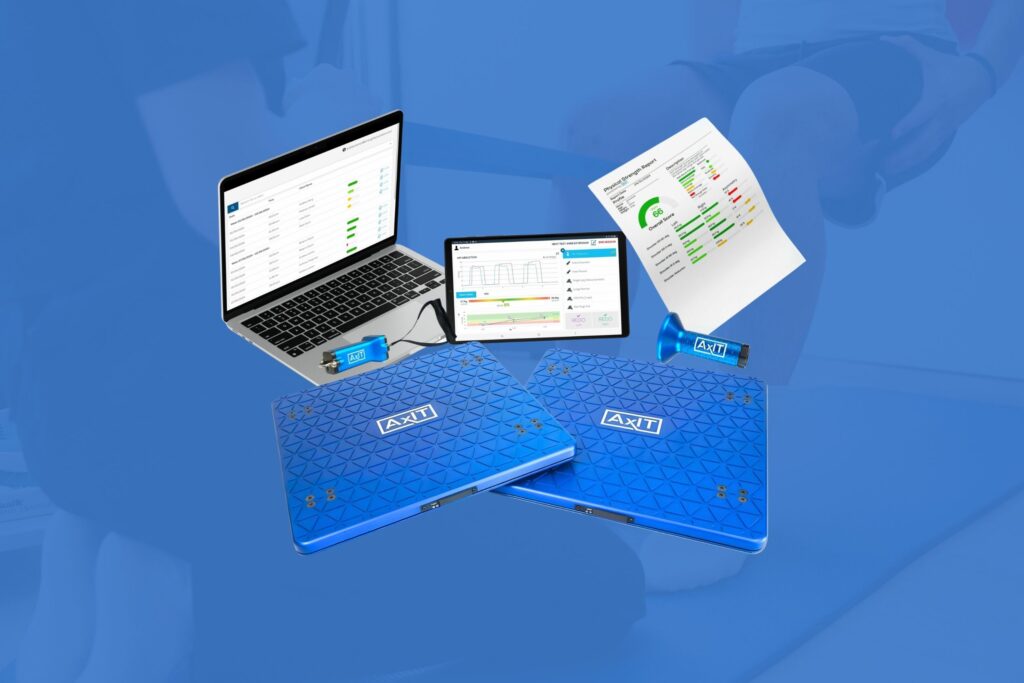
Top coaches and performance centers use digital dynamometers, dual force plates, and integrated assessment software to measure baseline strength. These modern systems capture precise kinetic data during functional movement screens. The technology automatically logs the results and generates professional reports without requiring complex manual data entry.
Tools like the AxIT system provide a comprehensive suite of objective measurement hardware. They are purposely designed for physiotherapists, sports performance centers, gyms, and wellness clinics seeking to objectively evaluate general strength and movement. These devices strictly track functional fitness metrics rather than diagnosing medical conditions, ensuring you operate smoothly within regulatory guidelines.