
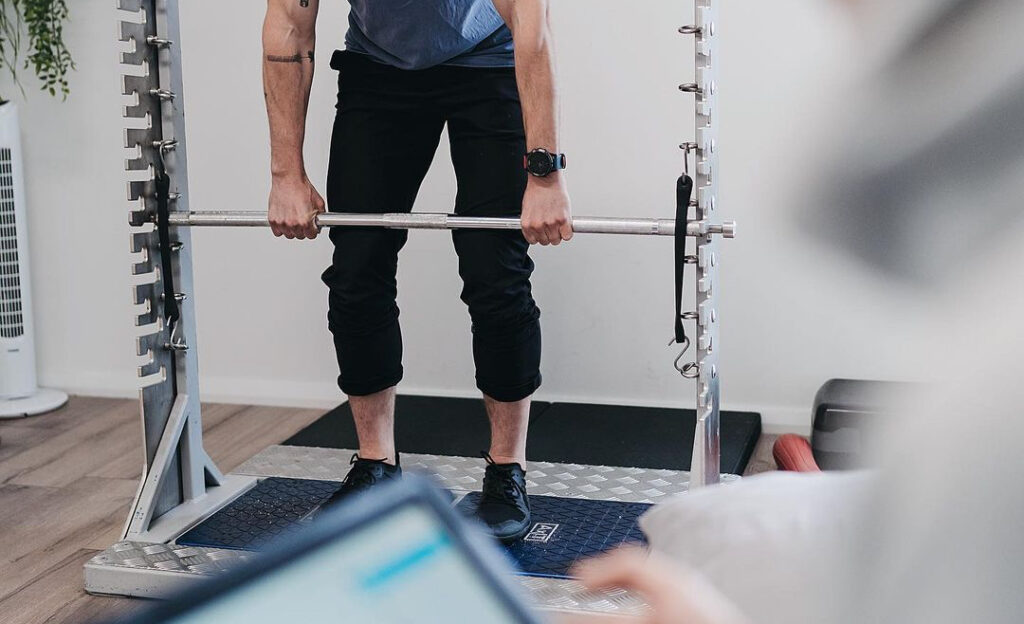
Objective strength assessment technology is no longer confined to elite sports labs. Force plates, handheld Dynamometers, and integrated assessment systems are now accessible to private physiotherapy clinics, exercise physiology practices, and sports coaching programs across Australia and the US. The challenge is no longer access. It is knowing which system actually fits your setting, your clients, and your business model.
This guide covers every decision criterion a buyer should work through before committing to a system.
What Does A Dynamometer Or Force Plate Actually Measure?
A Dynamometer or Force Plate measures force: the force your body exerts against the device or ground during movement. In a clinical or performance context, this produces metrics including peak force, rate of force development (RFD), bilateral asymmetry, jump height, reactive strength index (RSI), and eccentric utilisation ratio. These are objective, repeatable measurements that cannot be reliably replicated by observation or manual muscle testing.
Compared to the Oxford Scale used in manual muscle testing, Dynamometry and Force Plate data offers categorical advantages. The Oxford Scale grades strength on a 0-to-5 point system, where clinician-to-clinician variability runs at roughly 15-20% according to studies on inter-rater reliability in musculoskeletal assessment. Dynamometery or Force plate measurements, when properly calibrated, deliver repeatability within 1-2% across sessions. That is not a marginal improvement. It changes the kind of clinical decisions you can make and the kind of progress you can demonstrate to clients.
Handheld dynamometers extend that objectivity to isolated muscle strength testing: knee extension, hip abduction, shoulder rotator cuff strength, grip, and 40+ other assessments that are difficult or impossible to assess accurately with a force plate alone.
The Six Criteria That Actually Matter When Buying
1. Does the system integrate Force Plates and Dynamometers in one platform?
The single most important purchasing decision for most clinics is whether all assessment devices connect through one unified software platform. A system where force plates, handheld dynamometers, and tension dynamometers report to the same app, generate unified client reports, and store data in one place produces fundamentally different clinical workflows compared to running three separate tools with three separate data streams.
The administrative overhead of consolidating data from multiple platforms is significant. More critically, fragmented tools make client reporting slow and inconsistent, which reduces the probability that practitioners actually use the data in consultations. The AxIT System by Strength By Numbers addresses this directly: the Stomp-IT force plates, Push-IT handheld dynamometer, and Pull-IT tension dynamometer all connect to the same AxIT app, producing unified reports from a single session.
Most competing systems in the market are either force plate specialists or dynamometry specialists, not both. Buyers who want integrated measurement should confirm at the point of purchase whether integration is native or whether it requires third-party tools, manual export, or workarounds.
2. How accurate is the measurement, and how is that validated?
Accuracy claims from hardware manufacturers should always be interrogated. The relevant questions are: what is the test-retest reliability across sessions, what is the measurement precision (typically expressed as a percentage of reading), and has independent validation been published for this specific hardware?
For force plates, published validation studies typically report precision within 1-3% for ground reaction force measurement on research-grade systems. Portable systems have historically been assumed to sacrifice accuracy for portability, but this assumption does not hold uniformly. Research published in peer-reviewed sports science literature has increasingly validated portable force plate platforms against laboratory-grade systems for common clinical metrics including countermovement jump height and isometric peak force. Buyers should request specific validation data from vendors rather than accepting general accuracy claims.
For handheld dynamometers, inter-device and inter-session reliability is the relevant standard. A 2020 systematic review in the Journal of Orthopaedic & Sports Physical Therapy found that handheld dynamometry demonstrates acceptable test-retest reliability (ICC > 0.85) for most lower limb muscle groups when standardised positioning protocols are followed, which places the reliability burden partially on clinical protocol, not hardware alone.
3. What is the total cost of ownership?
Purchase price is rarely the whole story. The total cost of ownership for a strength assessment system includes: hardware cost, software subscription or licence fees, training and onboarding costs, warranty and replacement terms, and the opportunity cost of a system that practitioners abandon because it is too complex to use consistently.
The market currently sits across three broad tiers:
| Tier | Typical Profile | Price Signal |
| Enterprise / research grade | Lab systems, hospital networks, elite sports programs | High capital cost, often subscription-based software |
| Mid-market integrated | Clinic-grade systems for general and SMB practices | Moderate, with outright purchase options available |
| Entry-level portable | Single-device dynamometers, basic jump mats | Low upfront, limited clinical scope |
Strength By Numbers is positioned in the mid-market tier with a purchase model that includes outright ownership, 1-to-5-year finance plans, and multi-system pricing for group practices. It is currently the only system in the Australian market offering a 30-day money-back guarantee, which shifts meaningful purchase risk from the buyer to the vendor.
For solo practitioners or smaller clinics evaluating whether the investment will pay for itself, the business case typically rests on structured assessment programs. One UK allied health clinic documented increasing its five-session program price from £350 to £545 after integrating objective assessment into its offering, with no reduction in client uptake, as described on the Strength By Numbers website. The underlying logic is replicable: clients paying for a program that includes measurable outcomes at the start and end perceive higher value than clients paying for sessions.
4. Is the system genuinely portable?
Portability is often claimed and rarely defined. For a system to be functionally portable for field use, it needs to meet three practical standards: it must fit in a bag or case a practitioner can carry to a school, sporting club, or outdoor venue; it must set up in under two minutes; and it must not require mains power.
Force plate dimensions matter as well as weight. A platform with a height above 3 cm creates a tripping hazard and affects standing mechanics. Stomp-IT force plates measure under 3 cm in height with a 40 x 40 cm footprint, making them among the smallest dual-force plate options available without compromising the surface area required for bilateral jump testing. The full AxIT System is wireless and battery-powered, designed for practitioners who screen athletes at sporting clubs or run satellite clinics.
Coaches and practitioners who regularly travel between locations should also assess the software experience outside a clinic network: does the app function offline, does data sync reliably, and is the interface designed for use without a desk setup?
5. How does client-facing reporting work?
Client engagement with assessment data is directly correlated with treatment adherence. Research on exercise adherence consistently shows that clients who understand their own progress data are more likely to complete rehabilitation programs and return for reassessment. A system that produces technically accurate data but presents it in a format only a clinician can interpret has limited value as a client engagement tool.
The most effective client-facing reporting systems use visual benchmarking: showing a client not just their score, but how that score compares to a normative reference population matched for age, sex, and body mass. The AxIT System uses a traffic-light format that translates strength data into immediate, legible feedback. Green means on target or above average. Amber means developing. Red means a specific deficit has been identified. A client does not need to understand rate of force development to understand that their left quadriceps is red while their right is green.
This matters commercially as well as clinically. Clients who see measurable progress in objective data are more likely to refer others and return for preventive reassessment after discharge.
6. What training and onboarding does the vendor provide?
A system that takes three months to integrate into clinical workflow is functionally more expensive than its price tag suggests. Onboarding quality varies significantly across vendors. Buyers should assess: is training included in the purchase price, how long does it take a new practitioner to reach competency, is there ongoing education support, and does the vendor offer a library of standardised protocols practitioners can follow without building from scratch?
Strength By Numbers includes access to 150+ educational videos and a dedicated training portal with the AxIT System. This is a meaningful differentiator for smaller practices that cannot allocate significant staff time to training but need consistent protocol adoption across a team.
Which System Is Right for Your Setting?
– Solo physio or small clinic: Prioritise ease of onboarding, portability, and client-facing reporting. An integrated system that a single practitioner can set up, run, and explain to clients in a matter of minutes is worth a premium over a more powerful system that requires dedicated training and can take 30 minutes to set up and execute testing on. The AxIT System is specifically built for this context.
– Multi-site group practice: Standardisation is the priority. A system where all sites run identical protocols and report to the same platform produces comparable data across practitioners, which supports both clinical quality control and business performance tracking. Multi-system pricing arrangements are worth negotiating upfront.
– Clinic adding performance services: If you are adding sports performance testing to an existing rehab-focused practice, look for a system that handles both bilateral jump testing and isolated muscle strength in the same platform. Running two separate systems for two service lines creates fragmentation that undermines the client experience.
– Performance coach working across clinic and field: Portability, wireless operation, and a fast setup protocol are non-negotiable. A system that requires 20 minutes to calibrate before use is not a field testing tool.
– Practice replacing manual muscle testing: The transition from subjective to objective assessment requires practitioner confidence in the data and client confidence in the process. Prioritise systems with strong client-facing reporting and built-in benchmarking, since these are the features that make the shift from manual testing legible to clients who have no reference point for what a dynamometer number means.
Frequently Asked Questions
What is the difference between a force plate and a jump mat?
A jump mat measures flight and ground contact time only. A force plate measures the full ground reaction force profile throughout a movement, including rate of force development, peak force, impulse, and landing mechanics. For clinical use, force plate data is significantly richer and produces metrics that directly inform exercise prescription. Jump mats are a lower-cost tool suited to field screening where jump height alone is the target metric.
Is a portable force plate as accurate as a lab-grade system?
For the metrics most relevant to clinical and performance practice including countermovement jump height, bilateral asymmetry, and isometric peak force, published validation studies have shown portable force plates to be acceptably accurate when compared against laboratory reference systems. Accuracy varies by manufacturer. Buyers should request independent validation data specific to the hardware they are evaluating rather than relying on category assumptions.
What should I look for in a handheld dynamometer for a physio clinic?
The most important criteria are test-retest reliability (look for ICC values above 0.85 in published validation data), the number of muscle groups the device can assess, and whether it integrates with your force plate software. A standalone dynamometer that produces data in a separate system creates reporting overhead. If you are already using a force plate platform, prioritise a dynamometer that connects natively to the same app.
Do any force plate systems offer a money-back guarantee?
The AxIT System by Strength By Numbers is currently the only system in the Australian market offering a 30-day money-back guarantee. The guarantee applies to the full system purchase and is conditional on the practitioner completing the standard onboarding protocol. No equivalent guarantee is publicly offered by other vendors in this category.
How much does a professional force plate system cost for a small clinic?
Entry-level single force plates start around a few thousand dollars. Integrated clinical systems combining dual force plates and dynamometry typically sit in the mid-market range, with options to purchase outright or finance over one to five years. The AxIT System offers 1-to-5-year finance plans and multi-unit pricing for group practices. Exact pricing requires a direct conversation with the vendor, as configurations vary. The relevant comparison is not the hardware cost alone but the total cost of ownership against the revenue potential of structured assessment programs.
Can the same system be used for both physio rehab and sports coaching?
Yes, provided the system supports both bilateral jump testing and isolated muscle strength assessment in the same platform. The AxIT System covers countermovement jump, drop jump, isometric mid-thigh pull, sprint gate timing (via the AxIT Timing Gates), and 40+ isolated muscle group tests with the Push-IT and Pull-IT dynamometers. Practitioners who work across clinical and field environments can run consistent protocols in both settings using the same hardware and app.
What metrics should I prioritise when first introducing strength testing to a general clinic?
Start with bilateral asymmetry and normative comparisons for the muscle groups most relevant to your caseload. For a general physio clinic, knee extension and flexion strength, hip abduction, and grip strength give you high-yield data for the most common presentations. Add jump testing and rate of force development once practitioners are confident in isometric protocols. Introducing too many metrics at once slows adoption and makes client communication harder.
Book a one-on-one discovery session at strengthbynumbers.com to discuss configuration, pricing, and clinical workflow integration that suits your needs.